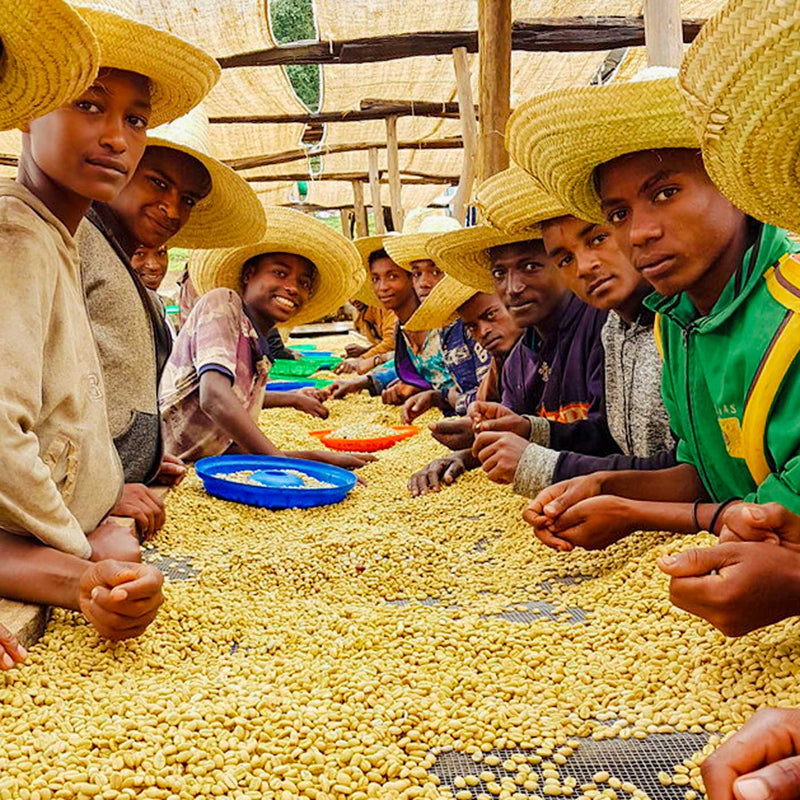




A few months ago, I received an invitation from This Side Up, our partner for several of our coffees. They proposed a trip to Ethiopia. Naturally, I was immediately intrigued - after all, we already have a coffee from there: Fruity Franny. Exceptionally delicious, yet we knew little about its origins or the people behind it. This journey felt like the perfect opportunity to trace Fruity Franny’s roots, to “get it right.” To explore new collaborations, meet the people who grow and process our coffee, and bring their faces and stories back to you - our customers.
But I was just as curious about the country itself - Ethiopia, where it all began, still considered the cradle of Arabica coffee. The name Kaffa is even said to be the origin of the word coffee (through the Arabic qahwa and the Turkish kahve).

A journey to the pure essence
And so we set off - a cheerful bunch: three people from the TSU team, two roasters (including myself), and a documentary maker. The schedule was full: first, we visited farmers in Sheka under the inspiring guidance of Gidhé. Then we travelled to the Yirgacheffe region, where the charismatic Tsedenia from coffee company Mocca welcomed and guided us.
I’ve visited many coffee farms and met countless wonderful people. I love immersing myself in other cultures, listening to stories, observing how people live, and seeing how coffee brings color and hope into their lives. I always return inspired - even if such trips are often intense and exhausting. Yet this one felt different. More intense. More pure. Everything in Ethiopia breathes authenticity and connection - with nature, with each other, with time itself. It was as if I had come closer to the very soul of coffee.


Nu Bunna Tetu — the Soul of Ethiopian Hospitality
In Ethiopia, coffee is a living ritual. Perhaps it has to do with the fact that the country was never colonized and thus preserved so many of its traditions. The Ethiopian coffee ceremony Nu Bunna Tetu literally means, “Come, let’s drink coffee”, is a beautiful example of that: a ceremony not just about making coffee, but about connection. About attention. About taking a moment to slow down.

The coffee ceremony is an essential part of social life. Family, friends, and neighbors gather to talk, laugh, share stories, and simply be together.
It begins with the aroma. The hostess (usually a woman of the household) washes the green coffee beans and roasts them in a pan over an open fire. As the beans slowly darken, the room fills with a deep, earthy fragrance.
The hostess often waves the fragrant smoke toward her guests — a symbolic act that awakens the senses and brings everyone together.

After roasting, the beans are hand-ground with a mortar and pestle, then brewed in a jebena, a traditional clay coffee pot with a long neck. The coffee is brewed three times, each round carrying its own meaning. Refusing a cup is considered impolite. The ceremony is often accompanied by burning incense and serving roasted grains or popcorn.
Around the jebena, there is always conversation and laughter. Women share stories, gossip, village news, or words of wisdom. As Tsedenia told me:
“Women usually talk about their social issues. It’s women’s private time. Kids are asked to go out and play. Men are usually not part of that moment.”

There are no prayers - the ritual isn’t religious - yet the atmosphere feels almost spiritual. Sometimes there’s soft music, sometimes only the crackle of the fire and the laughter of children. The world may be rushing by, but around the jebena, life slows down - and people connect.
During our visits to villages and coffee farmers, we had several opportunities to experience this ritual up close. It’s hard to capture in words what happens there. The daily gathering around coffee is so pure, so natural, and therefore so powerful. It’s no longer just about coffee - it’s about humanity itself, deeply rooted in traditions and generations.
It leaves you silent. And at the same time, you realize how loudly silence can speak - in the land where coffee took its very first breath.